Skip to content
Summarize with
Roadside assistance for an EV works the same way it does for a gas car in one sense you call, someone drives out, you get moving again. But the “how” changes almost everywhere else. A responding driver needs to know the vehicle’s drivetrain layout before hooking anything up, because pulling an EV’s wheels along the pavement can send electricity back into a high-voltage system that was never designed to receive it that way. That’s the core reason EV emergency roadside services look different from a standard tow call, and it’s why the wrong equipment on scene can turn a flat tire into an expensive repair bill.
Most breakdowns aren’t dramatic, and most calls to EV emergency roadside services end up being one of a handful of repeat issues. A flat tire, a drained 12-volt battery, a key fob that won’t communicate with the car account for the overwhelming majority of calls. What’s different is what happens after the driver arrives. A gas car can usually be pulled with a wheel-lift or dragged a short distance in neutral without much risk. An EV generally can’t, and knowing that distinction ahead of time saves both time and money on the side of the road.
This guide walks through what actually happens during Roadside assistance for electric Cars, why coastal driving conditions add their own wrinkle, and what to expect if you ever need a tow along the northeastern North Carolina coast. As a complete guide to roadside assistance, it also explains the EV-specific considerations drivers should know before calling for help. According to the National Highway Traffic Safety Administration’s interim guidance for high-voltage vehicles, towing and recovery operators need vehicle-specific training before handling EVs safely which tells you this isn’t a topic dispatchers can treat as an afterthought. A 2024 analysis reported by TIME found that AAA American Automobile Association responded to roughly 160,000 EV roadside calls in a single year, up sharply from just a few years earlier, and that tire failures made up the largest share of those calls by a wide margin.
What Makes Electric Vehicle Roadside Assistance Different From a Gas Car Breakdown
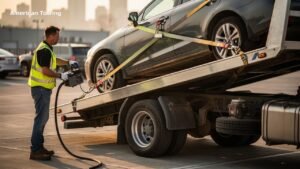
The single biggest factor is the drivetrain. In most gas vehicles, shifting into neutral physically disconnects the wheels from the engine, so a tow truck can drag the car short distances without consequence. In most EVs, the electric motor stays connected to the wheels even when the car is off. Spin those wheels on the pavement and the motor can act like a generator, pushing voltage into a system that’s supposed to be isolated. That’s the mechanical reason nearly every EV manufacturer requires flatbed transport, and it’s the first thing a dispatcher for EV emergency roadside services should confirm before a truck ever leaves the yard.
This is where electric vehicle roadside assistance starts to diverge from what most drivers grew up expecting. A wheel-lift truck the kind that hooks under the front tires and drags the rear is fine for plenty of gas cars. It’s the wrong tool for almost any EV, and a technician who doesn’t ask about drivetrain type before arriving is one who hasn’t done this enough times to know better.
The second factor is weight. A battery pack can add anywhere from 800 to 1,500 pounds compared to a similarly sized gas car. Straps, ramps, and tie-down points rated for a Camry aren’t automatically rated for a Mustang Mach-E or an F-150 Lightning. Roadside assistance for electric cars that’s actually built around EVs means the flatbed, the winch, and the tie-downs are rated for that added mass, not just the truck showing up with whatever gear was already on board.
What Happens When an EV Breaks Down Along Local Causeways and Coastal Routes
A driver stranded on Route 158, a beach access road, or one of the bridges connecting the barrier islands to the mainland is dealing with a specific set of variables: limited shoulder space, salt-laden air, and — depending on the season traffic that doesn’t slow down for a stopped vehicle the way it might inland. What happens next depends almost entirely on the type of breakdown, and it’s the reason EV Emergency Roadside Services dispatchers ask more questions upfront than a typical gas-car tow call would.
| Breakdown Type | Can the Driver Fix It Roadside? | Towing Required? | EV-Specific Handling |
|---|---|---|---|
| Flat tire, spare available | Sometimes, if a full-size spare is present | Only if unsafe to drive | Torque specs and wheel sensors differ by model; incorrect lug torque can trip a TPMS fault |
| Flat tire, no spare (common on EVs) | No | Usually yes | Many EVs ship with a repair kit only, not a spare — flatbed to a tire shop is typical |
| Dead 12-volt battery | Occasionally, with a jump pack | Sometimes | Jump point location varies; some models require accessing it through the frunk or a hidden panel |
| Drained main battery (0% charge) | No | Yes | Flatbed only — the vehicle can’t be pushed or rolled to a charger |
| Software or “brick” fault | No | Yes, to a dealer or service center | Wheels must stay off the ground even though the issue isn’t mechanical |
The row that surprises most drivers is the flat tire without a spare. Quite a few EV trims skip the spare entirely to save weight and trunk space, shipping a sealant kit instead which doesn’t help with a sidewall puncture or a pothole strike, both common on older coastal roads with heavy salt-corrosion patching.
Salt Air, Sand, and Humidity the Hidden Factors Behind Coastal EV Breakdowns
Anyone running EV emergency roadside services near the coast learns quickly that battery chemistry doesn’t love heat, and it doesn’t love the kind of humidity that sits over the coast for most of the summer. High ambient temperatures push EVs to run their battery cooling systems harder, which draws down range faster than the dashboard estimate suggests. A driver who plans a trip based on a “40 miles remaining” reading in July might find that number drops quicker once the AC and battery cooling are both working at once.
Salt air is the other issue, and it’s one that gas car owners don’t think about the same way. Corrosion around 12-volt battery terminals and connector housings happens faster near the coast, which is part of why a dead 12-volt is one of the more common non-tire calls out here. It’s a smaller battery than most drivers expect, usually about the size of a lawnmower battery, tasked with waking up every high-voltage system in the car, and salt-accelerated corrosion on its terminals is an easy thing to miss during routine maintenance.
Can an Electric Car Be Towed the Same Way as a Gas Vehicle?
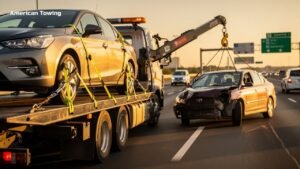
No and this is the guidance that matters most if you’re ever the one calling for help. Nearly every EV manufacturer, along with the NHTSA’s interim high-voltage vehicle guidance referenced earlier, specifies flatbed transport with all four wheels off the ground. Wheel-lift towing, where two wheels stay on the pavement, is standard for a lot of gas vehicles but is not appropriate for most EVs because of that motor-to-wheel connection described above.
This is the detail most drivers only learn about once they’ve already called for EV emergency roadside services and a truck is on its way. There are secondary reasons too. Some EVs have a “tow mode” or “transport mode” that needs to be activated before loading it releases the parking brake and adjusts the stability control system so the flatbed loading process doesn’t fight the car’s own safety systems. A driver on scene who doesn’t know that mode exists can spend twenty extra minutes trying to winch a car that’s actively resisting the process.
Electric Car Towing Guide: What Happens Step by Step
Here’s roughly what a properly run call to EV emergency roadside services looks like from the moment you dial to the moment your car is secured on a flatbed.
- Dispatch confirms vehicle type
The driver taking your call should ask for the make, model, and whether it’s fully electric or a hybrid this determines which truck gets sent. - A flatbed is routed to your location
Not a wheel-lift truck, unless the technician confirms your specific model allows partial-wheel towing. - The technician checks
vehicle is fully powered down before touching anything near the charging port or undercarriage. - Tow mode or transport mode is activated
if the model requires it, which unlocks the parking brake electronically. - The vehicle is winched onto the flatbed
with all four wheels clear of the road surface. - Straps and wheel nets rated
The vehicle’s actual weight is used, accounting for the battery pack’s added mass. - The car is transported
to a charging station, a dealer, a repair shop, or home wherever makes sense for the specific issue.
The Mistake Most EV Owners Make Before Calling for Help
The most common misstep isn’t mechanical it’s what drivers say when they call EV emergency roadside services in the first place. Someone with a Dead 12-Volt Battery in an Electric Car often describes the problem as “my car won’t turn on,” which sounds identical to a drained main battery from a dispatcher’s chair. Those are two very different repairs. A dead 12-volt is often a fifteen-minute jump. A drained high-voltage battery means a flatbed and a charger, full stop. Telling the dispatcher which warning lights appeared, or whether the car still shows a range number on the dash, helps route the right truck the first time instead of the second.
The other mistake is attempting a jump start without knowing where the access point is. On plenty of EVs, the 12-volt jump terminals aren’t under a traditional hood they’re behind a panel in the frunk, or accessible only through a specific port. Guessing at it, or worse, trying to jump from the wrong terminals, risks damaging low-voltage electronics that are expensive to replace.
Flat Tire Assistance for Electric Cars: Why It’s Not as Simple as a Spare
Flat tire assistance for electric cars runs into two complications a gas car owner rarely deals with. First, weight heavier vehicles put more load on a jack point, and using the wrong point on an EV’s flat battery-pack floor can dent the enclosure protecting the battery itself. Second, many trims genuinely don’t carry a spare, which means a puncture that would be a ten-minute roadside fix on a gas sedan becomes a tow to the nearest tire shop instead.
Calls tied to EV emergency roadside services skew heavily toward tires for exactly this reason. The AAA data referenced earlier found that tire-related issues make up close to half of all EV roadside calls, tied partly to the instant torque of electric motors putting more stress on tread and sidewalls than a comparable gas engine. Locally, that gets compounded by sand and shell debris that tends to accumulate along shoulder areas near beach access points.
Things to Think About Before You Actually Need EV Roadside Assistance
A little preparation now changes how smoothly EV emergency roadside services go if you ever need them on short notice.
Know your two modes
Look up whether your specific model has a transport or tow mode before you’re stranded. Most owner’s manuals cover it in a page or two, and knowing it exists in advance saves time when you’re anxious and the sun’s going down.
Check what’s actually in your trunk
If your EV doesn’t carry a spare, keep a tire sealant kit and a portable inflator on hand it won’t fix every puncture, but it buys options that a bare rim doesn’t.
Ask about flatbed capability when you call
Not every provider runs equipment rated for the added weight of a battery pack; confirming this upfront avoids a wasted trip and a second call.
Watch your 12-volt maintenance
Coastal corrosion accelerates faster than most manuals account for. A terminal check during routine service catches problems before they strand you.
Plan charging stops with a buffer, especially in summer
Battery cooling draws down range faster than the dash estimate on hot, humid days, which matters more on longer coastal routes with fewer charging options between towns.
Answers to Common Questions
Drivers usually have a handful of specific questions once they understand the flatbed requirement, so here’s what tends to come up.
How does roadside assistance work with an electric car compared to a gas car?
The dispatch and arrival process is similar, but the equipment differs. EVs almost always require flatbed transport, and the technician needs to know the vehicle’s drivetrain and tow-mode requirements before hooking anything up.
Is EV Emergency Roadside Services the same thing as a standard tow?
Not quite it’s a tow call handled by a provider with EV-rated flatbed equipment, drivers trained on tow-mode activation, and knowledge of where 12-volt access points hide on different models.
What happens when an EV breaks down with zero charge?
There’s no jerry-can equivalent for electricity. The vehicle gets flatbedded to the nearest charging station, dealer, or home, since it can’t be rolled or pushed any meaningful distance under its own power.
Can an electric car be towed with a standard wheel-lift truck?
Generally, no. Most manufacturers require all four wheels off the ground, which means flatbed transport rather than the wheel-lift equipment commonly used for gas vehicles.
Is a dead 12-volt battery a big deal in an EV?
Not usually, it’s often a straightforward jump, similar to a gas car, though the access point location varies by model and sometimes requires opening a specific panel.
Does every EV have a spare tire for roadside repairs?
No. A number of trims ship with a sealant kit only, which is part of why flat tire calls for EVs more often end in a tow than a roadside fix.
EV Guidance for Drivers Along the Carolina Coast
The single habit that saves the most time and money is knowing your vehicle’s tow requirements before you need them: tow mode, jump-start access point, spare tire status. None of that information matters until the moment it matters enormously, usually on a shoulder with traffic passing close and the light fading. Pair that knowledge with a provider offering genuine EV emergency roadside services flatbed equipment rated for EV weight, and drivers who know tow-mode and most roadside situations resolve in under an hour instead of turning into a multi-day repair because the wrong truck showed up first.
Reliable Assistance When Your EV Won’t Move
American Towing Service provides EV emergency roadside services with flatbed equipment sized for the added weight of EV battery packs and trains drivers on tow-mode activation and 12-volt access points across common EV models, which matters most on the causeways and beach routes where shoulder space is tight and cell service can be spotty.
Contact American Towing at 435-231-1116 or email alansudweekstrucking@gmail.com to talk through your specific vehicle before you need a tow, or to get a truck moving toward you if you’re already stranded. Knowing who to call and knowing they’ll show up with the right equipment is most of what turns a bad afternoon into a minor delay.
Sources
- National Highway Traffic Safety Administration — Interim Guidance for Electric and Hybrid-Electric Vehicles Equipped With High-Voltage Batteries
- TIME — The Main Reason EV Drivers Call AAA For Help is Not Dead Batteries
- AAA — Roadside Assistance in an Electric Car