Summarize with
The cost of a winch-out service in southern Utah is $100 to $250 for a basic pull. The total increases to $250 to $1,200 or more when the job includes a ditch, deep mud, a rollover or a trail miles away from the pavement. Those are estimated ranges for rural Utah, and the clock, the distance, and the way the vehicle is sitting decide where a real bill lands.
According to the Federal Highway Administration, 24 percent of weather-related collisions occur on snow, slush, or ice. In fact, a slip off the pavement that doesn’t result in a collision still leaves a vehicle nose down in a ditch.
Winch-Out Service Cost by Situation
The depth of the vehicle stuck and the distance that the truck has to travel are key factors in determining the winch-out service cost. If you’re close to the road then expect to pay $100 to $250. If you have a severe recovery then expect to spend $500 to $1,200 or more.
Every figure below is an estimated daytime total for rural southern Utah. Add 20 to 50 percent after dark, on weekends, and on holidays.
| Situation | Estimated total | What you are paying for |
|---|---|---|
| Simple pull: upright vehicle within 50 feet of a maintained road | $100 to $250 | Dispatch, one anchor point, and about 30 minutes of work |
| Ditch, snowbank, or mud up to the axles | $250 to $600 | Longer rigging, a second anchor, and up to 2 hours on scene |
| Vehicle on its side or wedged against something | $500 to $1,200 | Multiple anchors, snatch blocks, and careful uprighting |
| Trail recovery, 10 or more miles off pavement | $450 to $1,100 | Travel time, off pavement mileage, and longer time on scene |
| Tow after the recovery | $75 to $125 hookup fee, plus $3 to $6 per mile | Billed separately because towing is a different job |
Vehicle Recovery Cost: What Goes Into the Bill
The four categories that make up a vehicle recovery cost include a dispatch fee, labor on scene, mileage and add ons including an after hours surcharge. Labor drives most of the variation because the pull itself takes minutes while the rigging takes an hour.
- Dispatch fee, $75 to $125. Covers the truck, the operator, and the drive out. Ask whether it includes mileage.
- Labor, about $125 to $200 per hour. The operator looks for anchor positions, identifies the positions at which the cable will not twist a frame, and estimates the vehicle’s movement when it becomes unfastened. A bumped bumper is more expensive than the half hour that was invested in avoiding it.
- Off pavement mileage, $3 to $6 per mile. Usually charged only when the truck leaves the road network, as it does on forest and ranch roads.
- After hours premium, 20 to 50 percent. Applied to the subtotal.
- Storage, $20 to $50 per day. Only when the vehicle goes to a yard, not straight to a shop or home.
Three sample bills show how the parts combine. Each uses a $150 hourly labor rate and is an estimate, not a posted price.
| Scenario | Dispatch | Labor | Mileage | After hours | Total |
|---|---|---|---|---|---|
| Pickup 20 feet into a snowbank off Highway 89, 10 a.m. | $85 | 0.5 hour = $75 | None | None | $160 |
| SUV nose down in a ditch, 9 p.m., 2 hours of work | $100 | 2 hours = $300 | None | 25% of $400 = $100 | $500 |
| Truck 13 miles down a dirt road, daytime, 2.5 hours of work | $100 | 2.5 hours = $375 | 13 miles at $4 = $52 | None | $527 |
A group once called from a mountain with a vehicle stuck 13 miles down a rough dirt road, the kind of stretch most trucks won’t attempt. Alan made the drive anyway. A job like that is the third row, and mileage is the smallest line on it. The hours are the cost.
| Blue Tip: Inquire if drive out is listed in the quote. Presuming that the $100 quote includes $52 of mileage, the $140 quote is the cheaper option. |
|---|
What Moves the Price Up or Down
The number you call is moved by five factors: distance travelled by the truck, the type of vehicle, the position of the vehicle in the truck, the time of calling and the weight of the vehicle. Those are the factors affecting winch-out service cost that a dispatcher is probing when a first call turns into a list of questions.
Distance from the truck
Where the nearest recovery rig can be a long drive away, the trip out is often the biggest line before a cable moves. A call from Kingston and a call from Panguitch are both from the same workshop in Circleville, with a difference in drive time and, consequently, cost. Customers report hours that the crew had to drive to reach them, which are eligible as mileage or travel labor time.
What the vehicle is stuck in
Dry snow is the cheapest to work with. In contrast, wet clay sucks it up and pulls it down, and the pull should be slow and steady, or even two anchor points sharing the pull. The truck can also find no grip on the ice, potentially resulting in better ground and more running of cable.
How the vehicle is sitting
Upright and 30 feet from the road is a quick pull. The cable has to lift as well as drag when it is nose down in a ditch. When a vehicle is leaning against a fence, tree, or guardrail, it must first be eased away from the object. On its side is a different job entirely, with multiple anchors, careful uprighting, and the most labor hours.
Time of day and weather
The premium is 20 to 50 per cent after dark, on a weekend and during a holiday period. A storm that doesn’t show up on a rate card is one that causes a rise in the wait time and a pile up in calls on the roadway because of the ice.
Weight and drivetrain
A loaded stock trailer, a motorhome, or a one ton dually needs heavier rigging and often a second truck. Heavy recoveries can run double the price of a light vehicle.
Stuck Vehicle Recovery Cost in Southern Utah
Stuck vehicle recovery cost is higher around Circleville, Kingston, Junction and Panguitch than it would be in a city. The roadways that trap people are often dirt roads and the nearest truck to help is usually far away. There’s ice on the curves and unplowed sections of Highway 89 in winter, and muddy roads in the forest during the summer months when the rain falls.
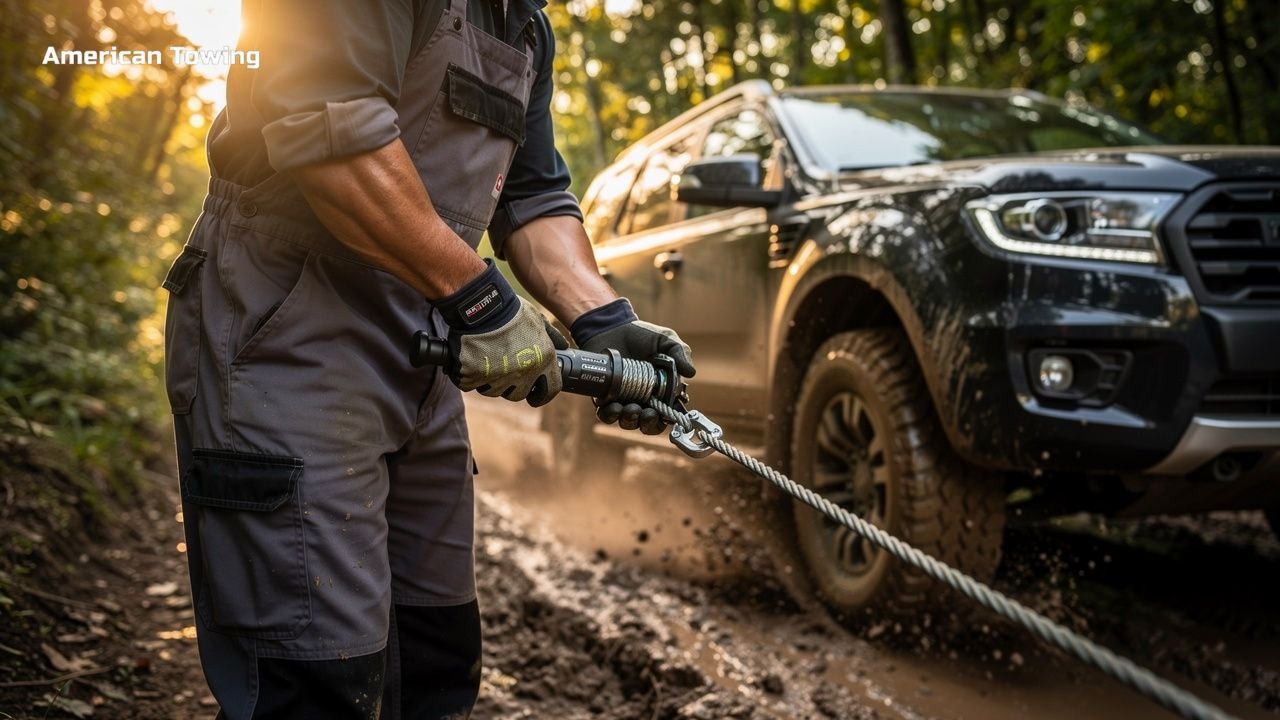
Cold months are the busiest season for a winch-out service here, but not every call is a highway slide off. One customer stuck five miles up a muddy Dixie National Forest trail was pulled free with a rope and a pickup and called the price very reasonable. The skill is telling a small job from a large one before the truck leaves.
| Blue Tip: No street address? Give the last town you passed, your direction of travel, and anything you can see, such as a fence line or a cattle guard. That is usually enough to find you. |
One thing surprises people. Utah caps some tow prices but not this one. The Utah Department of Transportation states that rates for tows the vehicle owner requests are set by agreement between the owner and the company and are not regulated by the department, while tows ordered by police and private lot impounds fall under a state fee schedule.
A recovery you call in yourself generally fits the first group. Your protection is a clear price agreed before the cable is hooked up, not a state ceiling.
Vehicle Winching Cost Compared With a Tow or a DIY Pull
Vehicle winching cost is typically higher than a short tow and a heavy recovery, as towing involves a set of skills. But it does not necessarily require another truck. The do-it-yourself (DIY) pull is free until it fails, then it is a bumper, a frame or otherwise.
- Winch out: $100 to $1,200 or more. Returns the vehicle to solid ground without loading it from the side.
- Tow only: $75 to $125 hookup plus $3 to $6 per mile. Fine when on pavement, wrong tool when in mud – a tow hook pulling at the wrong point can bend a frame or tear off a bumper.
- Doing it yourself with an unmarked strap or rope – free until a strap that is not rated to the job snaps, a cable wraps around a tree and slips.
If the vehicle is on a flat surface, tires are just in loose gravel or shallow drift and the frame is clear of the ground, skip the call. Remove snow behind the wheels, place traction boards or floor mats under the drive wheels, and take it easy, don’t spin.
If the frame, bumper or differential is on the ground, the vehicle is tilted, or the tires are buried beyond the rim, it is worth the money to hire a winch-out service.
How to Get a Firm Quote Before the Truck Rolls
Provide the dispatcher with 6 elements and you’ll start with a number that you can work around: Your location and what the vehicle is stuck in, how far the vehicle is off from the road, whether the vehicle is up or down, the vehicle type, loaded or unloaded, and if a tow is needed after. The crew agrees to the price before leaving, not when the cable is connected.
The questions are provided first because asking “how much does a winch-out service cost?” will yield a range of information. Honest winch-out service pricing is based on assumptions, such as one truck and one pull, an upright vehicle sitting on ground that holds. If the scene changes, that is if the vehicle sinks instead of slides, then the number changes, but before work begins, not on the invoice.
There are three things to be wary of:
- A definite and immediate price without any questions asked. This is a quotation for the easiest version of the job, the revision is coming after.
- Talking about price before the truck arrives and then you have to negotiate with them on a shoulder that has no leverage.
- A second truck on the bill with no explanation. You may need a second unit to hold or stabilize a vehicle at times and be informed of this before the vehicle begins to roll.
Request the final invoice with the dispatch, the labour hours, mileage and surcharges listed on separate lines.
| Blue Tip: Be sure to take a picture from a safe place before calling. A single image of the vehicle is worth more than three minutes of description to the dispatcher, and should help record the scene if filing an insurance claim. |
Ways to Lower the Final Bill
It is the cheapest recovery which is described accurately the first time you call. The next cheapest will be the one that you find yourself not driving anymore. Since the longer you keep driving the wheels, the more problems you are going to have and the more a simple pull into a ditch job you will be making.
- Do not leave the car if it’s safe to do so, and place flashing lights near a road.
- Avoid wrapping a cable on a tree or post for anchoring a pull. May snap or slip.
- See your roadside coverage first. The availability of a winch-out service may be dependent on the distance from a maintained road and whether these costs are covered by the plan, be sure to read the distance limit and dollar cap, and inquire about the availability of a local plan operator or a dispatch requirement for the plan.
- A “pull” at daylight time will not incur the after hours premium if the vehicle is safe, off the road and you are not in danger from the weather. If it’s blocking a lane, call now.
- Request to have it delivered directly to a store after the pull, to avoid any storage fee.
FAQs
How much does it cost to have a winch professionally installed?
For a bolt on winch, expect roughly $150 to $500 in shop labor plus $500 to $2,000 for the winch. So most installs land between $650 and $2,500. It is pushed up by a custom winch bumper or a 12,000 pound winch bumper. Obtain a written quote from a shop that installs winches.
What is the 80/20 rule for towing?
It’s a safe rule: towing with 80 percent of the towing capacity of your vehicle is a rule to follow, and the other 20 percent should be considered a safety margin for hills, heat, wind and trailer that’s heavier than you expect. That is a 10,000 pound rating, which is the maximum of 8,000 pounds.
What is considered a reasonable towing fee?
A reasonable tow ranges from $75 to $125 per hookup and $3 to $6 per mile, and the costs are 20 to 50 percent higher after hours. A 10 mile tow with a $100 hookup and $4 per mile comes to $140. Reasonable also implies that you can see the price itemised and quoted prior to the arrival of the truck.
What is a winch out service?
A recovery using a winch cable and rated anchor points to recover a vehicle that has come to a stop in mud, snow, a ditch or off road conditions. Towing is not like that – it involves transporting a vehicle that is already on a solid surface.
Which towns do you cover for recoveries?
Circleville, Kingston, Junction, and Panguitch, along with the highways and forest roads around them. The workshop is at 355 W Main St in Circleville.
What if I’m stuck on a trail with no address?
Common out here. Provide the last town seen, direction of travel, and what you can see nearby.
Will I know the price before the truck is hooked up?
Yes. The crew asks a few questions, gives you a number and confirms the price before they go. Vaguely answering questions on distance, terrain and position is acceptable.
Does insurance or roadside coverage pay for a recovery pull?
Some plans do. Generally, when the vehicle is a short distance from a maintained road. Coverage can differ. So be sure to check your policy.
Call for a Price Before the Truck Leaves
Stuck right now? Call American Towing Service at 435-231-1116 or email alansudweekstrucking@gmail.com, describe the scene, and get a price for your winch-out service before the truck leaves the workshop.
They are known for having a 5.0 rating on Google and answering calls 24/7. The crew operates out of 355 W Main St Circleville, UT 84723 and has recovered over 15 years.
Sources
- Road Weather Management Program: Snow and Ice, FHWA. Snowy and slushy and icy pavement crash statistics on a National scale.
- Towing Complaints and FAQs (Motor Carrier Division, Utah Department of Transportation). Explains consent and non consent towing in Utah and which rates the state caps.