Skip to content
Summarize with
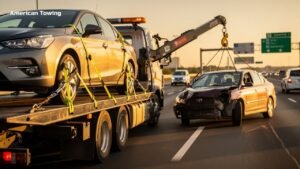
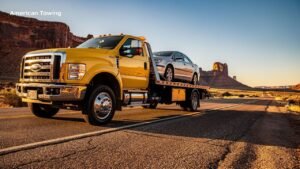
Flatbed towing works by driving or winching a vehicle onto a hydraulic bed that tilts down to ground level, then raising the bed flat so all four wheels stay off the road for the entire trip. We run flatbed calls out of Circleville, Utah, where that trip usually means US-89 canyon grades, not flat city streets.
How does flatbed towing work in one line: your car never touches the road again until it arrives. That is why it is the default choice for all wheel drive vehicles, frame damage, or a transmission that will not turn.
What Happens During the Flatbed Towing Process
The flatbed towing process breaks into six steps, and every one of them matters for whether your car arrives the way it left.
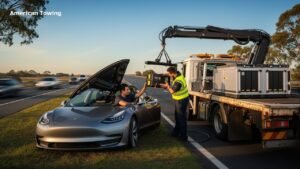
- Arrival and assessment. The driver checks whether the vehicle rolls, steers, and brakes normally, since that determines whether it can be driven onto the bed or needs to be winched.
- Positioning the truck. The tow truck backs up so the bed lines up with the vehicle, usually on the flattest, most level stretch of shoulder available.
- Lowering and tilting the bed. A hydraulic system tilts the bed until its rear edge meets the ground, creating a ramp.
- Loading the vehicle. A drivable car is driven straight on. A car that will not move under its own power gets pulled up with a winch cable attached to the frame.
- Raising and leveling the bed. Once the car is fully on, the bed rises back to flat and locks.
- Securing and transport. The driver anchors the vehicle at four points, does a final walk around, then drives the route to the shop, dealer, or storage yard.
Cover any one of those headings and read only the sentence under it. Each step should make sense on its own, because that is the test of whether a process is actually explained or just described in general terms.
How Do Tow Truck Operators Load a Vehicle Onto a Flatbed?
Flatbed tow truck loading comes down to two methods, and the choice isn’t up to the driver’s preference. It’s dictated by whether your car can move.
Method 1: Self-loading (car starts and rolls)
The driver puts it in neutral, releases the parking brake, and drives it straight up the ramp under its own power. Under two minutes on a dry, level shoulder.
Method 2: Winch loading (car can’t move on its own)
If the car is unable to move itself for whatever reason, be it a seized engine, locked axle or accident damage, the driver attaches a winch cable to a specified manufacturer’s frame attachment and slowly drags the car up the slope. Not pulling from a designated tow spot could lead to bending a bumper mount or cracking the plastic fascia, as well, and that’s one reason many DIY recoveries end up costing more than the tow.
How to Secure a Vehicle on a Flatbed
Not driver judgment, federal law. Under FMCSA’s cargo securement rules, a vehicle must be restrained front and rear against lateral, forward, rearward, and vertical movement, with a minimum of two tiedowns rated for the vehicle’s weight. Anything over 10,000 pounds falls under a stricter heavy equipment standard.
Why most operators use four
Most flatbed towing services go beyond the two tiedown minimum and use four straps or chains, one per wheel, since four points stop side-to-side rocking on rough pavement, not just front-to-back. Straps attach to the wheel or a factory frame point, never a suspension component, which flexes under braking and can loosen a strap over distance.
Yes, it gets rechecked
A driver who feels a strap shift after the first stretch of highway pulls off and retightens before continuing, standard practice on any commercial haul.
| Flatbed towing | Hook and chain/wheel lift | |
|---|---|---|
| How the car rides | All four wheels off the ground the entire trip | Two wheels on the ground, rolling |
| Best for | AWD, 4WD, low clearance, accident or drivetrain damage, long distance | Front wheel drive cars in working condition, short local tows |
| Risk to drivetrain | None, since nothing rotates in transit | Possible wear on the wheels that stay grounded |
| Typical load time | 5 to 10 minutes | 5 to 10 minutes |
| Cost | Usually higher | Usually lower |
When Do You Need Flatbed Vehicle Transport Instead of a Standard Tow?
Flatbed vehicle transport is not always the right call. A good towing company tells you when a cheaper method works just as well.
You need a flatbed if your car has all wheel or four wheel drive, since towing it on two wheels can spin the transmission or transfer case without lubrication and burn it out in miles. Same goes for any accident with frame or undercarriage damage, a seized brake or locked transmission, low clearance cars that would scrape on a standard tow, and trips long enough that wear on two dragging tires becomes real money.
You don’t need one, or a tow truck at all, for a dead battery on level ground. A jump start solves that in minutes for a fraction of the cost. Same with a flat tire if you’ve got a working spare and a safe spot to change it. Calling a flatbed for either is paying for equipment you don’t need.
Flatbed Towing on US-89 Through Piute County
Circleville is located at approximately 6,066 feet on US-89, between Panguitch to the south and Marysvale and Richfield to the north. It slopes upward and down through canyon grades, with long distances between towns, making what a tow call looks like out here different than in the city.
A breakdown outside a town of 550 people isn’t getting picked up by the next truck that happens by. Response times run longer than Salt Lake or St. George, and winter adds ice and reduced visibility, exactly the conditions where a hook and chain tow becomes a bad idea. A driveline already stressed by cold and elevation dragging two wheels on a slick grade means more damage, not less.
Utah’s DMV doesn’t set towing or storage rates. That’s negotiated directly between you and the tow company, so get a number before the truck arrives, not after (Utah DMV, Impounds).
Ready to Arrange Flatbed Towing for Your Vehicle?
American Towing Service has held active interstate operating authority under USDOT 938632 since 2009 and runs flatbed service out of Circleville, Utah. Call 435-231-1116 or email alansudweekstrucking@gmail.com for a flatbed tow anywhere along US-89 or in the surrounding Piute County area.
FAQ
Is flatbed towing more expensive than a regular tow?
Usually. Flatbeds cost more to buy and maintain than a hook and chain rig. The trade off is no wear on your tires, brakes, or drivetrain, which matters more on longer tows.
Can a flatbed tow truck carry any vehicle?
Most passenger cars, SUVs and light trucks fall under the normal weight and length regulations. If your truck, RV or heavy equipment is larger, you will need a special carrier, so please call ahead and describe the size of your equipment.
How long is the average time for a flatbed tow to come to you?
Depends on traffic and distance. But the time range was 20-30 minutes in denser cities and longer in rural areas, where there are long distances between towns. Be honest, tell the dispatcher right away if you can only estimate.
Does American Towing Service run flatbed calls on US-89 through Piute County?
Yes, out of Circleville, covering US-89 through Piute County including the stretch between Panguitch and Marysvale.
If I get stuck in the snow in the middle of the trip between Circleville and Marysvale, what should I do?
Stop on the shoulder of the road (if possible), hazards on, stay in the vehicle and wear your seatbelt. If the shoulders on this stretch are narrow and visibility quickly diminishes, it is better to stay there and be visible than to flag down someone on foot.
Will the Department of Motor Vehicles in Utah be able to help me with towing and storage costs?
No. The DMV is responsible for titling, registration and impound releases, not towing fees. Fee disputes are between you and the tow company.
Sources:
- NHTSA: Emergency Towing Guidance — Flatbed towing and vehicle transport guidance.
- FMCSA: Cargo Securement Rules — Federal cargo securement requirements, including tiedowns and preventing vehicle/load movement during transport.